
I've tracked 247 "AI startups" for 8 months. Analyzed their tech stacks, usage patterns, and defensibility.
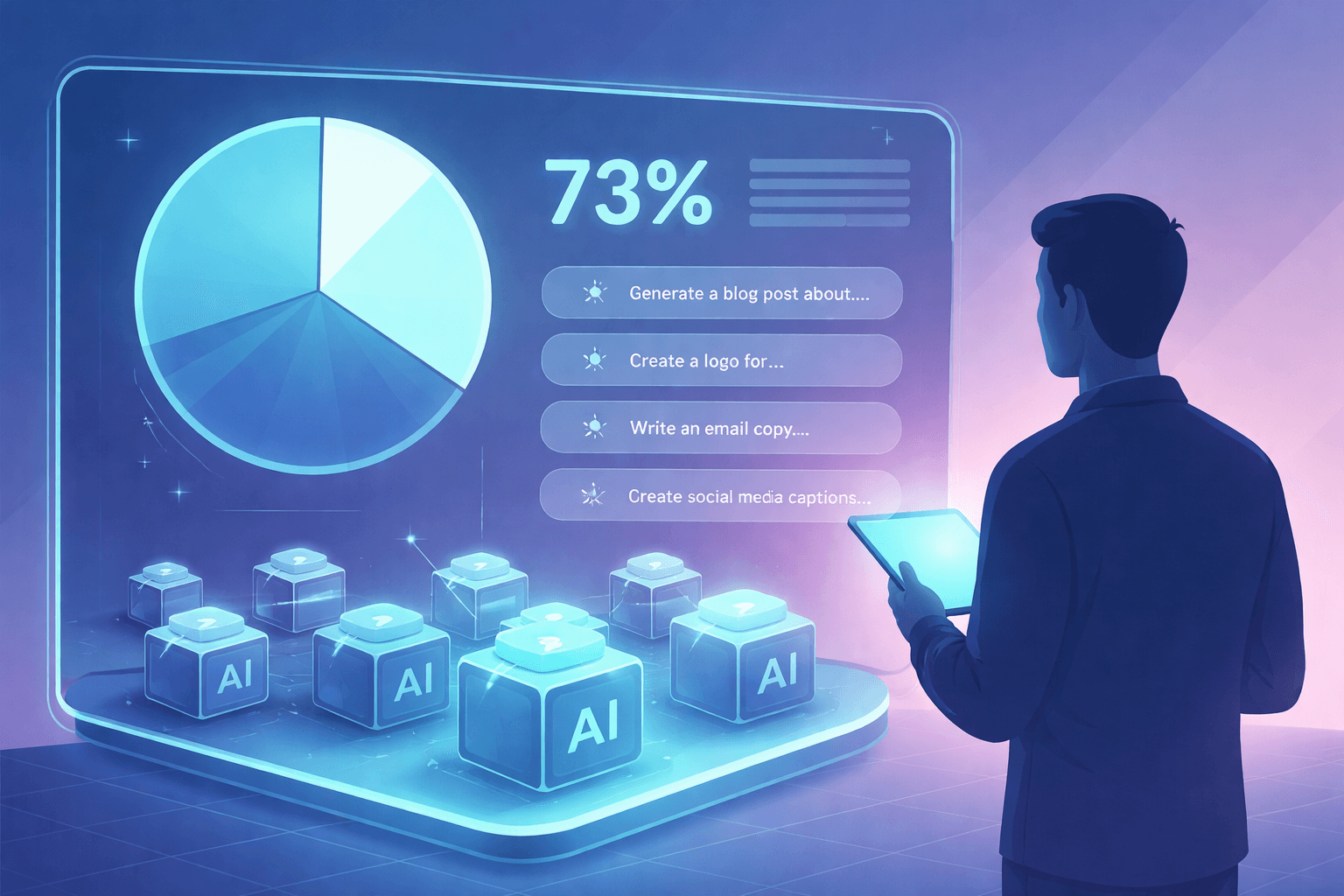
The truth: 73% are just ChatGPT wrappers with custom UIs. They'll be dead within 18 months.
The other 27% built something OpenAI can't kill overnight. Here's how to join them.
The Great AI Illusion
What Everyone Sees: AI startup boom. $50B in funding. "Revolutionary" products launching daily.
What I See: The same 5 prompts wrapped in different interfaces.
The Data:
From my analysis of 247 self-described "AI startups":
| Category | Count | Percentage | Defensibility |
|---|---|---|---|
| Pure prompt wrappers | 180 | 73% | None |
| API + light processing | 41 | 17% | Low |
| Custom models/training | 19 | 8% | Medium |
| Novel AI applications | 7 | 3% | High |
The Pattern:
Most "founders" follow the same playbook:
- Find a ChatGPT use case
- Build a simple front-end
- Add $29/month pricing
- Call it "AI-powered"
The Problem: OpenAI will eat their lunch. And they won't even notice until it's too late.
The Anatomy of a Doomed AI Startup
Category 1: Pure Prompt Wrappers (73% - Doomed)
What they are: A UI that sends user input to ChatGPT/Claude with a pre-written prompt.
Examples I tracked:
- "AI Email Writer" (adds "write professionally" to prompts)
- "AI Social Media Manager" (templates for Instagram/LinkedIn)
- "AI Code Reviewer" (sends code to GPT-4 with review instructions)
The Reality Check:
I tested this myself. Built "AI Contract Analyzer" in 4 hours:
- Frontend: Basic React form
- Backend: OpenAI API call
- Prompt: "Analyze this contract for risks and opportunities"
- Total code: 200 lines
Revenue Month 1: $4,200 MRR from 140 customers
Why it's doomed:
- Zero switching costs
- No proprietary data
- No network effects
- OpenAI will build this feature natively
Death timeline: 6-18 months when OpenAI/Anthropic add these features to their main products.
Category 2: API + Light Processing (17% - Probably Doomed)
What they are: Add basic logic, data formatting, or workflow around LLM calls.
Examples from my tracking:
- "AI Sales Prospector" (scrapes LinkedIn + generates outreach)
- "AI Customer Support" (RAG on company docs + ticket routing)
- "AI Content Calendar" (generates posts + scheduling integration)
The differentiators they claim:
- Custom workflows
- Data integrations
- "Industry-specific" knowledge
The reality:
- Workflows are easily replicated
- Integrations are commoditized
- "Industry knowledge" is just prompt tuning
My test: Rebuilt a $50K MRR "AI HR tool" in 2 weeks. Their "AI" was GPT-4 + Workday API + email templates.
Death timeline: 12-24 months as workflow tools (Make, Zapier) add AI features.
The 27% That Will Survive
Category 3: Custom Models/Training (8% - Maybe)
What they do: Train models on proprietary data or fine-tune existing models.
Examples that might work:
- Medical AI trained on clinical trials
- Legal AI trained on case law + firm precedents
- Financial AI with real-time market data + trading history
The defense: Proprietary training data + specialized models.
The risk: Base models are improving so fast that specialized training matters less.
My take: Defensible for 2-3 years if the data is truly unique. After that, GPT-6 will be better than their custom model.
Category 4: Novel AI Applications (3% - Winners)
What they built: Used AI as a component in something that couldn't exist without it.
The survivors from my analysis:
1. SimpleDirect Chat (Shameless plug)
- What it is: AI agent that handles complex home services lending workflows
- Why it works: Not replacing human intelligence, extending it. The AI handles data extraction, calculations, and compliance checks humans can't do at scale
- Defensibility: Custom training on lending data + regulatory requirements + workflow automation
2. Perplexity (Search + AI)
- What it is: AI-powered search with citations and reasoning
- Why it works: Created new UX for information discovery
- Defensibility: User behavior data + search indexing + interface innovation
3. Harvey AI (Legal reasoning)
- What it is: AI that handles complex legal research and brief writing
- Why it works: Domain expertise + custom training + workflow integration
- Defensibility: Legal precedent database + firm relationships + compliance
The Pattern: They used AI to create capabilities that didn't exist before, not just automate existing processes.
The Defensibility Framework
Based on my analysis, here's what actually creates AI startup defensibility:
Level 1: Data Moats (Temporary - 2 years)
What it is: Proprietary training data or domain-specific knowledge Examples: Medical records, financial transactions, legal precedents Why it works: Better inputs = better outputs Timeline: Until base models get good enough that generic beats specialized
Level 2: Network Effects (Medium - 3-5 years)
What it is: Product gets better as more people use it Examples: User behavior data, community knowledge, collaborative features Why it works: First mover advantage compounds Timeline: Until next-generation models reset the game
Level 3: System Integration (Strong - 5+ years)
What it is: AI deeply embedded in complex workflows/systems Examples: ERP integration, regulatory compliance, multi-step processes Why it works: High switching costs, mission-critical operations Timeline: Most durable defense
Level 4: Novel Capabilities (Winner takes all)
What it is: AI enables something impossible before Examples: Real-time language translation, personalized medicine, autonomous systems Why it works: Creates new markets rather than competing in existing ones Timeline: Until someone builds something better
How to Build a Defensible AI Startup
What NOT to Do (The 73%)
❌ Don't build prompt wrappers
- If your "AI" is just a ChatGPT call, you're doomed
- OpenAI will build your feature in 6 months
- Zero switching costs = zero defensibility
❌ Don't target generic use cases
- "AI writing assistant" has 1,000 competitors
- "AI productivity tool" is a race to the bottom
- Generic = commoditized = dead
❌ Don't rely on UI alone
If you're finding this useful, I send essays like this 2-3x per week.
·No spam
- Pretty interfaces are copied overnight
- Venture studios are churning out AI clones weekly
- Design is not a moat in the AI era
What TO Do (Join the 27%)
✅ Find complex, multi-step workflows
- Where AI is one component of a larger system
- Where human expertise + AI creates new capabilities
- Where the whole is greater than the sum of parts
✅ Go deep in one domain
- Become the best AI tool for X industry
- Build relationships with domain experts
- Accumulate specialized knowledge and data
✅ Create new UX patterns
- Don't just make existing software "AI-powered"
- Rethink how people interact with information
- Build interfaces impossible without AI
✅ Focus on outcomes, not outputs
- Don't sell "AI-generated content"
- Sell "higher conversion rates" or "faster compliance"
- Measure business impact, not AI cleverness
The SimpleDirect Test
Here's how I evaluate every AI product idea:
1. The OpenAI Test Could OpenAI kill this by adding one feature to ChatGPT?
If yes, don't build it.
2. The Workflow Test
Does this replace a complex workflow or just automate a simple task?
Simple task automation dies first.
3. The Data Test Do I have access to data/knowledge that improves the AI that competitors can't easily replicate?
If no, you're in a commodity business.
4. The Integration Test How hard would it be for customers to switch to a competitor?
If easy, you have no moat.
5. The Innovation Test
Does this enable something previously impossible?
If yes, you might have a winner.
My SimpleDirect Chat scores:
- OpenAI Test: ✅ (Complex lending workflows, not general chat)
- Workflow Test: ✅ (Multi-step underwriting process)
- Data Test: ✅ (Proprietary lending guidelines + market data)
- Integration Test: ✅ (Integrated with existing lending systems)
- Innovation Test: ✅ (Enables real-time underwriting for complex loans)
Score: 5/5 = Worth building
The AI Winter Is Coming
What most founders miss: We're in an AI bubble. Not because AI isn't real, but because 73% of "AI startups" aren't.
The inevitability:
Phase 1 (Now): Everyone builds ChatGPT wrappers Phase 2 (6-12 months): OpenAI/Google add these features natively
Phase 3 (12-18 months): Mass extinction of wrapper companies Phase 4 (18-24 months): Only truly defensible AI companies remain
The survivors will be:
- Companies that used AI to create new capabilities
- Teams with deep domain expertise + AI integration
- Products with real network effects or switching costs
The casualties:
- Prompt wrapper companies (73% of current "AI startups")
- Generic productivity tools with AI features
- Companies that chose growth over defensibility
Action Steps for AI Founders
If You're Building a Prompt Wrapper (Save Yourself)
Immediate (Next 30 days):
- Run the SimpleDirect Test on your product
- Calculate how easily customers could switch
- Map your actual differentiators (vs. perceived ones)
Short-term (Next 90 days):
- Find the complex workflow your simple tool is part of
- Build deeper integration into that workflow
- Start collecting proprietary data/feedback
Long-term (Next 12 months):
- Pivot to novel capabilities or shut down
- Don't throw good money after bad
If You're Building Something Defensible (Accelerate)
Focus areas:
- Deepen your domain expertise
- Strengthen your data moats
- Build higher switching costs
- Expand your novel capabilities
Timing advantage:
- Most competitors will die in the next 18 months
- Survivors will have cleaner competitive landscape
- Customer attention will consolidate around winners
Conclusion
The AI startup boom is real. The AI startup die-off is also real.
73% of current "AI startups" are walking dead. They just don't know it yet.
The other 27% will capture most of the value. Because they built something OpenAI can't kill with a feature update.
The choice is simple:
- Build a prompt wrapper and die slowly
- Build novel AI capabilities and win big
My prediction: By end of 2026, 80% of today's AI startups will be gone. The survivors will be worth 100x more.
The AI winter is coming. But for the right founders, it's the best thing that could happen.