
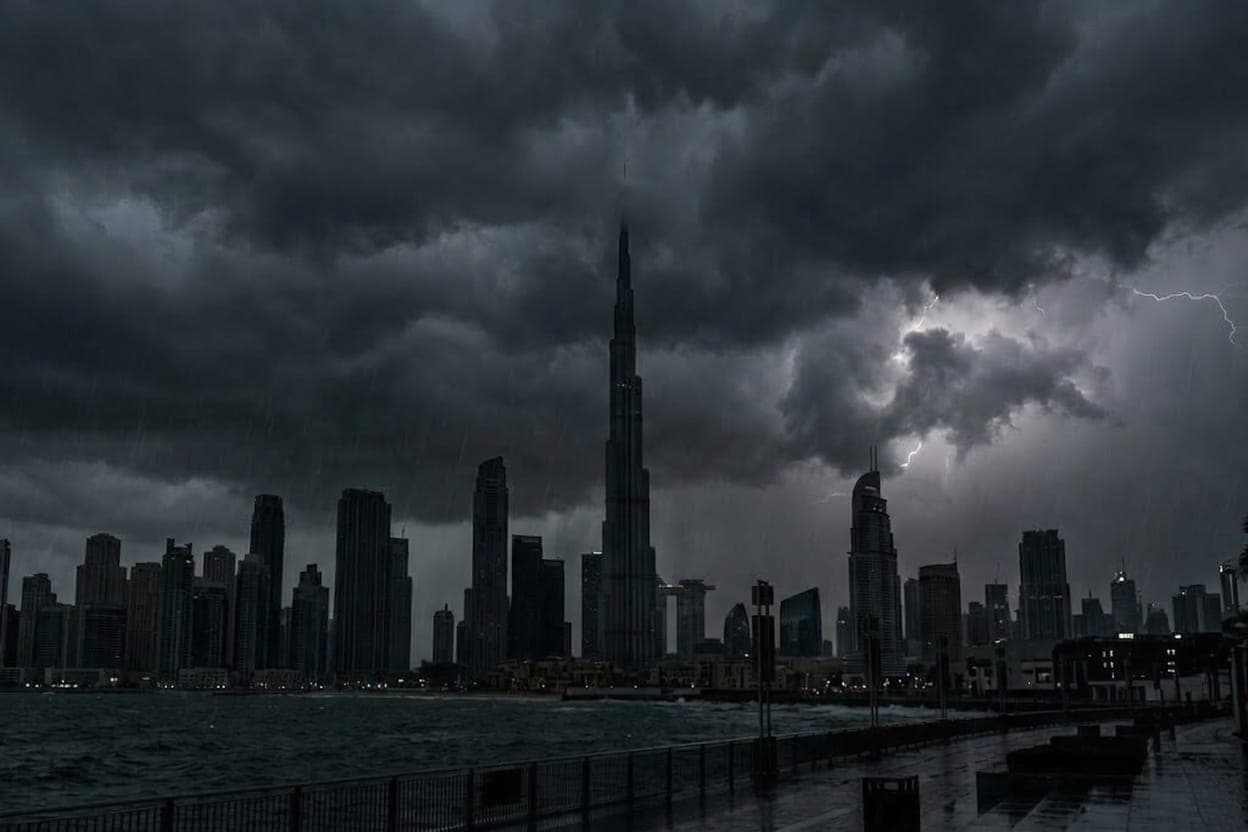
I love Dubai.
I've been there multiple times. I've sat in the lobbies of hotels I couldn't afford when I first visited and told myself, one day.
I've walked the Marina at night when the air finally cools down and everything feels possible. I've taken meetings where people talked about the future like it was already here.
I've told friends they should visit. I meant it.
But I never moved there.
And this weekend, the reason why became visible to the entire world at the same time.

On February 28th, the United States and Israel launched strikes on Iran.
Within hours, Iran struck back. Not just at Israel. At every country hosting US military bases in the Gulf.
Dubai. Abu Dhabi. Doha. Bahrain. Kuwait.
All of them. Simultaneously.
Jebel Ali Port — one of the busiest commercial ports on earth — caught fire.
The Fairmont on Palm Jumeirah, sold just weeks earlier for $325 million in a deal that was supposed to prove the Gulf hospitality market had never been stronger, burned on camera.
Dubai International Airport took damage. The Burj Al Arab was hit. Residential areas in Dubai Marina were struck.
Markets in Dubai and Abu Dhabi closed. Not for a day. For two days. Qatar Airways suspended all flights.
And then Abu Dhabi's Department of Culture and Tourism sent a letter. An official letter, on government letterhead, to every hotel in the emirate.
The subject line: "Extension of Guests' Stay Due to Travel Restrictions."

The message: your guests can't leave. Extend their stay. We'll cover the cost. Send your invoices to this email address.
That's real. That happened. The richest cities on earth became places you couldn't leave. And the government's response was to pick up the hotel tab until the airport reopened.
Money bought you a room.
It didn't buy you an exit.
What Dubai Actually Sold
I need to explain something about Dubai that most people don't think about.
There is no oil in Dubai. That's Abu Dhabi. Dubai is built entirely on a brand.
Real estate. Tourism. Logistics. Financial services. Aviation. Emirates airline alone is the connective tissue of global business between Europe and Asia.
Every single one of these industries runs on one proposition: Dubai is safe.
Safe. Modern. Neutral. Open for business. Insulated from the region's conflicts.
That was the pitch. And for twenty years, it worked beautifully.
Founders moved there for the tax advantages.
Family offices parked capital there. Wealth managers built entire practices around golden visas and DIFC structures. Instagram influencers sold the lifestyle.
Podcasters made it sound inevitable. Twitter threads made it sound like you were falling behind if you weren't already there.
I watched this wave happen in real time. Friends moved. Clients moved. People I respected made the jump.
And I kept asking a question that nobody wanted to hear: what happens when the region isn't calm?
This weekend, everyone got the answer.
Safe?
Missiles hit residential areas.
Modern?
The airport is damaged.
Neutral?
The UAE closed its embassy in Iran and picked a side.
Open for business?
Markets closed.
Insulated from the region's conflicts?
A port is on fire.
The Thing Nobody Mentioned
Here's what the Dubai influencers never told you.
The UAE hosts Al Dhafra Air Base and Al Minhad Air Base.
American and allied military aircraft operate from Emirati soil. Qatar hosts Al Udeid — the largest US military base in the entire Middle East.
Bahrain is home to the US Fifth Fleet.
These countries sold you safety while hosting the military infrastructure that made them targets.
Nobody noticed the contradiction when things were calm.
It became the only thing that mattered when the shooting started.
The founders who relocated to Dubai weren't told they were moving to a country with American military bases within range of Iranian missiles.
They were told about zero income tax. Year-round sunshine. Easy company formation.
The golden visa brochure didn't include a section on ballistic missile risk.
I don't say that to be cruel.
I say it because I've sat across from founders who made this decision, and I know the information they were given versus the information they needed.
Those are two very different sets of facts.
The Lie That Got Everyone
"Geography doesn't matter anymore."
I heard it a hundred times. Maybe you did too.
The world is flat. Work from anywhere.
Dubai is proof that you can build a world-class city in the desert through sheer force of will and capital.
Physical location is a legacy constraint. The internet made it irrelevant.
I never believed it.
Not because I'm smarter than anyone. Because I grew up between countries.
I've lived the reality of borders, visas, jurisdictions, and what happens when the assumptions about safety that everyone takes for granted stop being true.
Geography didn't matter — until it did.
Until a country 150 miles across the Persian Gulf started firing missiles and everything built on the premise of geographic irrelevance became a liability overnight.
150 miles. That's closer than New York to Philadelphia. There is no buffer. There is no warning time.
There is no distance that buys you options when the regional power across the water decides to shoot.
The founders who moved from Toronto, London, New York, or Singapore traded actual geographic safety for a tax rate and a lifestyle.
This weekend, the exchange rate on that trade became visible.
I Watched It Happen From Toronto
I want to be honest about something.
Saturday night, I filled up my gas tank.
Not because I was panicking. Because I understood what the Strait of Hormuz closing meant for oil prices, and I wanted to do it before the pump caught up to the futures market.
If you're finding this useful, I send essays like this 2-3x per week.
·No spam
Then I went home. And I watched.
I watched Dubai — a city I genuinely love, a city where I've had some of my best memories — take missile fire on live television.
I watched the Fairmont burn. I watched people post videos from their Marina apartments of explosions in the distance.
And I thought about the founders I know who are there right now. With their families. With their kids.
I wasn't scared. My airport was open. My city wasn't being bombed. My country isn't hosting military bases pointed at anyone. My gas tank was full.
That's not because I'm lucky. It's because I made a choice years ago about where to build.
And the thesis behind that choice — that jurisdiction matters, that geography is an asset class, that safety isn't something you outsource to a brand — held.
I didn't feel vindicated. I felt sad.
What I Tell Founders Now
If you're in Dubai right now, I'm not telling you to leave tomorrow.
The immediate crisis will pass. Flights will resume. The airport will be repaired. The Marina will look the same. Life will normalize on the surface.
But something broke this weekend that doesn't un-break.
The risk model updated. Permanently.
If you're making decisions about where to build your life — really build it, not visit, not vacation, build — on a 10, 20, or 30-year horizon, then the calculation is different today than it was on Friday.
The first thing I ask every founder who comes to me is: can you actually leave when it matters?
Not when things are good. When things are bad.
When the airport is damaged and flights are cancelled and 15,000 other people are trying to leave at the same time.
Abu Dhabi answered this question in writing on Saturday. No, you can't. They'll pay for your hotel though.
Then I ask: is your safety dependent on someone else's alliance holding?
If you're in a country that hosts foreign military bases, you're betting your family's safety on the relationship between your host country and whoever those bases are pointed at.
That relationship can change with one phone call. This weekend, it did.
And the hardest question, the one that makes people go quiet:
Are you confusing lifestyle with sovereignty?
Nice weather, good restaurants, low taxes, beautiful apartments — those are amenities.
They're not sovereignty.
Sovereignty is who controls your ability to operate. To move. To access your assets. To protect your family.
If the answer to any of that is "someone else," you don't have sovereignty. You have a lease on someone else's stability.
And leases expire.
I Still Love Dubai
I want to end where I started, because it matters.
This isn't a hit piece. I'm not dunking on a city to prove a point.
Dubai is a city built from nothing in the desert in two generations. That takes something real. Something most cities and most countries will never have.
But loving a place and trusting it with your life are two different things.
I love visiting New Orleans. I wouldn't build my life there.
It's below sea level in a hurricane zone. That's not a criticism. It's a fact. And facts don't care about how much you love a place.
Dubai is 150 miles from a hostile regional power.
It hosts military bases that make it a target. It has no democratic institutions to hold leadership accountable when things go wrong.
And its entire economic model depends on a brand that broke on live television on February 28th, 2026.
You can love a place and still tell the truth about it.
This weekend demanded truth.
The Thesis
I've been saying for years that where you build matters.
That jurisdiction is an asset class.
That money buys you options but it doesn't buy you sovereignty.
That the world was going to test these ideas, and when it did, the people who understood them would be positioned correctly.
And the people who didn't would find out the hard way.
This weekend, everyone found out.
The insurance market repriced overnight.
The aviation network that connected East and West through the Gulf fractured.
The talent pipeline that fed Dubai's growth started flowing in reverse. And the narrative that made it all work — that Dubai was the safe, neutral, inevitable choice — flipped.
Before this weekend, you had to justify not moving to Dubai. Now you have to justify staying.
The people who built on fundamentals — physical safety, institutional stability, exit optionality, real neutrality — woke up on Sunday and went to work.
Their airports were open. Their markets were trading. Their families were safe.
The people who built on a brand woke up to missiles, grounded flights, closed markets, and a government letter telling hotels to keep guests because they couldn't leave.
Everyone had an exit plan this weekend.
Almost nobody had an actual exit.