
The S&P 500 is down 9%. The NASDAQ just entered correction territory.
Oil hit $116 a barrel - up over 50% in a single month, the fastest surge since Saddam invaded Kuwait in 1990.
And the entire thing hinges on a 5-mile island and a 21-mile strait that most people couldn't find on a map 60 days ago.
The Island and the Strait
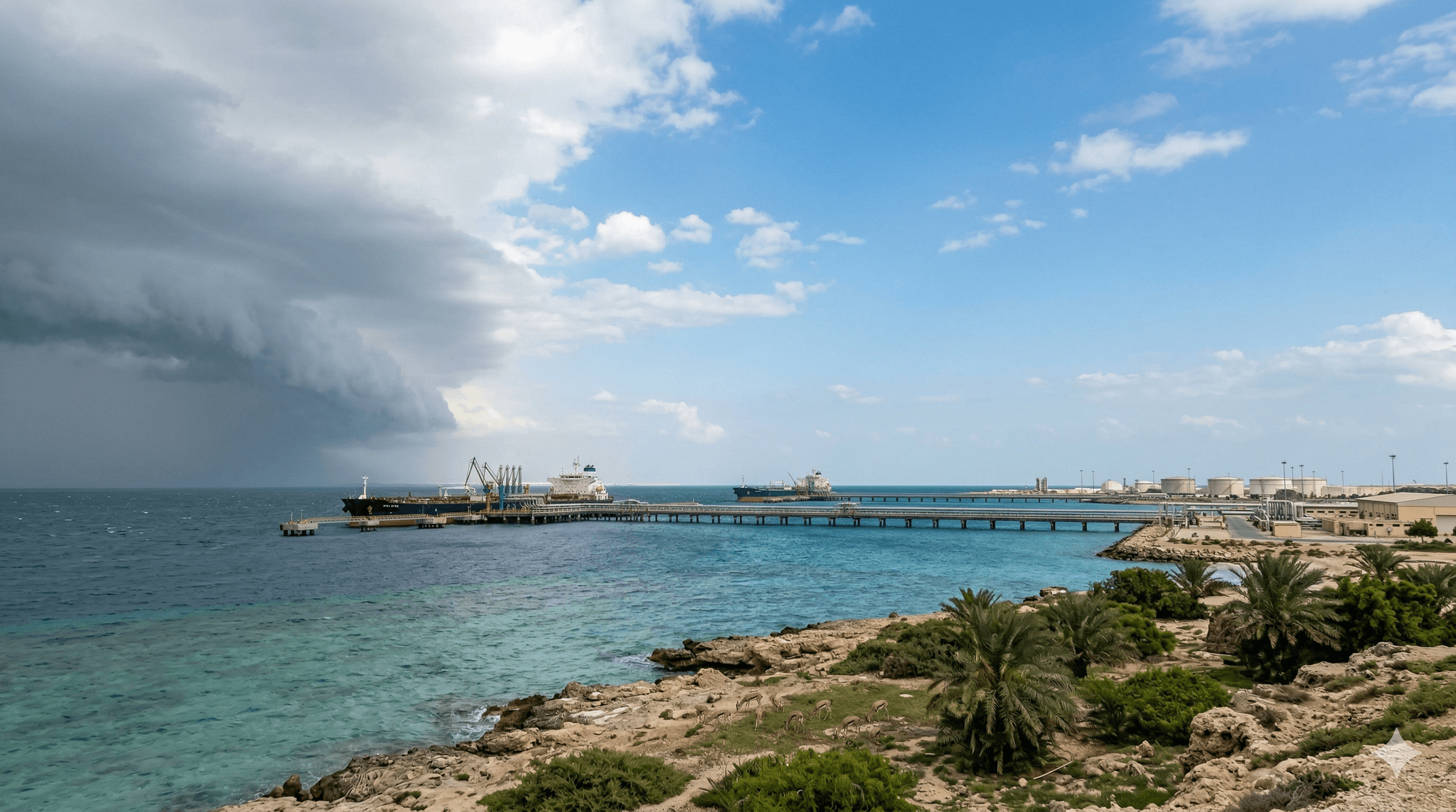
Kharg Island is a piece of coral off the coast of Iran.
It's roughly a third the size of Manhattan. 90% of Iran's oil exports pass through it.
The Strait of Hormuz is 21 miles wide at its narrowest point. 20% of the world's daily oil supply moves through it.
Before the war, 129 ships transited it every day. By the second week of March, that number was 4.
Two pieces of geography.
That's what your retirement account, your grocery bill, your heating costs, and the global economy are built on.
Nobody thought about this 60 days ago. Now it's the only thing that matters.
When Dependency Breaks
Japan gets 95% of its crude oil from the Gulf. Almost all of it passes through Hormuz. Their refiners are begging the government to release emergency stockpiles.
Australia just cut fuel taxes for four months because their consumers can't afford to fill their tanks. A liter of petrol hit $2.53 AUD.
Pakistan and Bangladesh get 99% and 72% of their liquefied natural gas from Qatar and the UAE - all of it through the Strait. They have limited storage. When the gas stops, the power stops.
Europe gets 12-14% of its LNG from Qatar. 30% of its jet fuel passes through Hormuz.
China gets a third of its oil through the Strait. India gets 40%. South Korea and Japan are just as exposed.
One-third of the world's seaborne fertilizer trade passes through Hormuz.
Farmers in Iowa and Kansas are watching fertilizer prices spike because of a naval conflict 7,000 miles away.
Your clothing costs more because 85% of polyethylene exports from the Middle East — the feedstock for synthetic fabrics — go through the Strait. Your packaging costs more. Your car parts cost more.
Maersk suspended all vessel crossings.
Hapag-Lloyd suspended all vessel crossings.
CMA CGM rerouted everything around the Cape of Good Hope.
Insurance premiums hit six-year highs. The ships stopped before the mines did.
The Dallas Fed estimates global GDP could fall up to 1.3% if this drags on. That would make it the worst energy-driven contraction since the 1970s.
All because of a 21-mile stretch of water.
The Invisible Assumption
This is not a war story. I'm not here to tell you who's right or wrong.
This is a dependency story.
Every country, every company, every portfolio on that list was built on the same invisible assumption: the oil will flow, the ships will pass, the strait will stay open.
That assumption was never tested because it never had to be.
It was the equivalent of assuming the sun rises - except it's not physics.
Want the full playbook? I wrote a free 350+ page book on building without VC.
Read the free book·Online, free
It's geography controlled by governments with their own interests, protected by a military arrangement that's one bad decision away from collapse.
And in 30 days, it broke.
Owning the Asset, Not the Infrastructure
Countries that depend on a single energy chokepoint discovered they don't control their own power grid.
Companies that assumed global supply chains would always function are watching their input costs double overnight.
Investors who thought geographic diversification meant "owning stocks in different sectors of the S&P 500" just learned that the entire index depends on whether a 21-mile strait stays open.
Everyone owned the asset. Nobody owned the infrastructure the asset depended on.
The Insurance Premium Nobody Paid
Here's what I keep coming back to.
The people who built real optionality before this crisis - different supply chains, different jurisdictions, cash on hand - they're not panicking.
They had plans that didn't depend on a single point of failure.
The people who didn't are trapped. Their portfolio is trapped. Their supply chain is trapped.
Optionality isn't a luxury. It's infrastructure. You either build it before the crisis or you don't have it.
The Strait of Hormuz has been a known vulnerability for decades.
Every defense analyst, every energy researcher, every intelligence agency in the world has war-gamed this exact scenario.
It was on every risk register. It was in every briefing. And almost nobody - not governments, not companies, not investors - actually built the redundancy to survive it.
Because building redundancy is expensive. It's slower. It looks wasteful in good times. Maintaining optionality when everything is working feels like paying insurance premiums on a house that never burns down.
Until it burns down.
What Comes Next
The Strait will eventually reopen. Oil prices will eventually normalize. Markets will recover. Ships will sail again.
But the lesson is permanent: if your wealth, your business, or your country can be wiped out because of a chokepoint you don't control, you don't own anything. You're renting stability from geography. And the landlord just raised the rent.
The question you should be asking right now isn't "when does this end?"
It's: "What else am I dependent on that I don't control?"
Because next time, it won't be Hormuz. It'll be something else. A chip fab in Taiwan. A rare earth mine in Congo. A cloud region in Virginia. A regulatory decision in Brussels.
The infrastructure of your life has single points of failure. Most of them are invisible.
Find them before someone else does.