On October 11, the ChatGPT app told me I'd used 6.1 billion tokens. The day before, it said 4.9 billion.
My Codex and Claude trackers showed hundreds of billions more over roughly 30 days. That's not counting ChatGPT.
I haven't audited any of it. I don't know exactly how ChatGPT counts input, output or cached tokens. I wouldn't add these numbers together and call it a measurement.
But here's what got me. None of it surprised me.
Billions of tokens had become background noise.
Then I read Andrej Karpathy's rough sketch of who actually uses AI. And I realized I'd started treating my own life as a preview of everyone else's.
The napkin math
In an October 11 post, which I read through AI Front Page's write-up, Karpathy sketched it out. Billions of people who have barely touched an LLM. Maybe 1–2 billion casual chatbot users. Around 20 million getting dramatically more out of it in professional work like code and math.
He called these napkin estimates. It's not a population study. There's no activity window. I don't know how close the numbers are.
Still, the picture did its job. It broke an assumption I didn't know I was making.
I work around AI all day. I read about it, build with it and run the company with it. Somewhere along the way it stopped feeling like a choice. It just became how work happens.
I knew most people don't work like this. I just wasn't remembering it when I thought about what people actually need from the technology.
What normal looks like for me
ChatGPT. Codex. Claude Code. Claude. Sometimes Gemini. Google's AI search. Perplexity, before that.
The list doesn't really capture it.
I have a CLI that launches sessions in the background. Those sessions talk to each other through infrastructure I've built. AI runs through our model research, our infrastructure work and our company operations. Work can be moving in one place while I'm dealing with something else.
People still direct it, check it and make the calls. I'm still responsible for what we do with the output. But a big part of the work now passes through these systems before it reaches me.
Asking a chatbot a question now and then is one thing. Organizing a company around the assumption that these systems are always there is another.
I'm far into the second one.
When a new task shows up, I'm already thinking about how AI handles it. Before I've picked a tool. Before I've consciously decided anything.
I can't imagine just stopping. I'd have to rethink what we attempt, how we split it up and how long we expect it to take.
That dependence crept in slowly enough that I stopped seeing it.
My parents use AI too
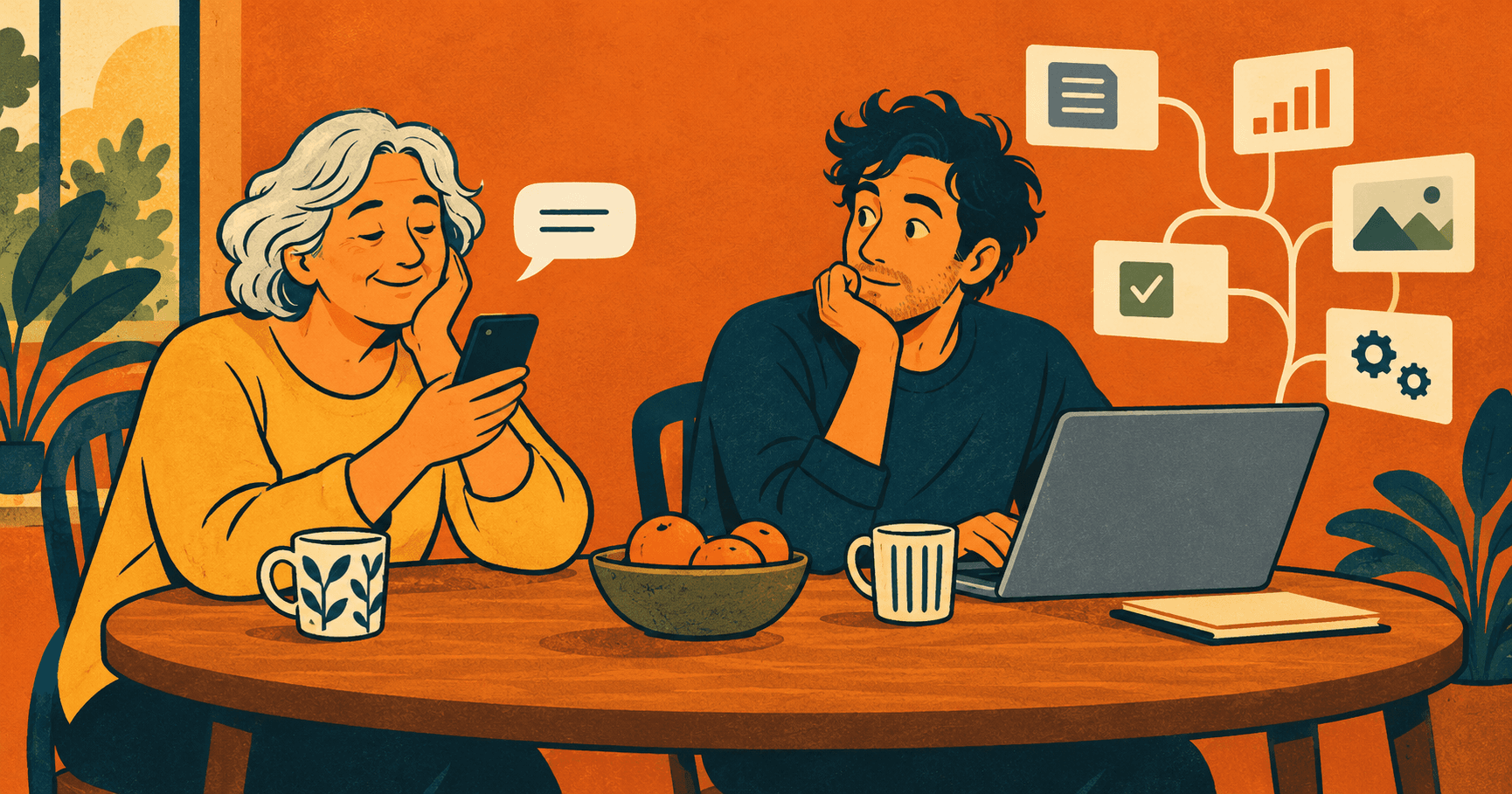
My parents are retired. They use Google's AI Overviews. They chat with AI on their phones. They follow AI news, partly because of what I do.
They're not running agents. They don't have background sessions talking to each other. There's no reason they should.
They're still AI users.
Put all of us in one box labelled "AI users" and the box hides everything that matters. What are we asking it to do? How often do we need it? What changes if it disappears tomorrow?
Those questions tell you a lot more than whether someone has opened ChatGPT.
My parents found uses that fit their lives. I don't look at that and think their next step is a terminal. My setup isn't their destination.
That should be obvious. It gets less obvious when almost everything I read and build is about getting more out of these systems.
A close friend who works at the front desk in my office tried Gemini. It wasn't good enough. They stopped.
I keep coming back to that.
Trying software and deciding it's not worth it is the most normal thing in the world. People do it all the time.
But it feels strangely far from my own experience. For me, walking away from AI would mean rebuilding a big part of my working life.
Would a different model or a better prompt have changed their mind? Maybe. But the experience they actually had gave them no reason to stay.
If you build these products, that's worth taking seriously.
I don't know how much of this gap closes
The easy story is that everyone's on the same road. Some of us just got there early. Everyone else catches up.
I'm not confident in that story.
Maybe some of today's occasional users end up relying on AI across their whole working day. Maybe others get what they need from a few answers on their phone. Some will use it inside other products and never care which model is underneath. Some will keep finding it doesn't help with the things they actually do.
The gap matters to me because the consequences could be huge. But I don't want to flatten very different lives into one race everyone is supposedly running.
I keep thinking about the internet. Does AI become ordinary the way the internet did, broad and uneven, with everyone leaning on it for different things? Or does a sharper line stay between having access to it and actually organizing useful work around it?
I don't know. My experience is evidence of one life changing very fast. It says much less about how anyone else's will change. Or whether they'd even want it to.
There's an opportunity question here I don't want to wave away. If some people learn to do far more with these tools, what gets easier for them? What stays out of reach for someone who had one bad experience and reasonably moved on?
I want to understand that difference. Without pretending it tells me whose work survives.
I don't understand the economics either
My usage also makes me wonder how the business underneath all this works.
How do subscriptions and promotional access absorb people who use these systems the way I do? Is part of the answer that people like me are rare, and most customers use far less?
Maybe. I don't know enough about provider costs or how usage is distributed to say.
A token counter doesn't answer it. It doesn't tell me what the provider actually spends. And volume alone doesn't tell me how efficiently I'm working. A big total could include useful work, repeated context, retries and things that didn't help. I haven't separated those well enough to claim anything.
So it's one more place where my own experience could distort the picture. If I start from myself as the typical customer, I'm asking the economics to explain someone who is nowhere near typical.
The distance I stopped seeing
What bothered me wasn't learning that other people use less AI.
It was realizing how little effort I'd been putting into remembering it.
My parents' use makes sense. My friend quitting makes sense given what they saw. My dependence makes sense for the work I chose. All three can be true without any of us being a preview of everyone else.
I still want to see how far I can push these tools. I can't imagine my work without them now.
But I'm less sure that living this deep inside the change helps me understand what it looks like from the outside.
That's what I want to pay more attention to.