Skip to content

Essays

Decisions, mistakes and changing beliefs about work, AI and building companies.

George Pu

By George Pu

Founder of SimpleDirect, an independent Canadian AI lab.

Why CBLRE Matters More Than the Model

Yesterday we released CBLRE — the Canadian Bilingual Legal and Regulatory Evaluation. Methodology and status clarification — October 11, 2026: This June account preserves the early proposal. The public CBLRE harness and methodology at revision b2d09fa describe a development-stage instrument with ongoing subject-matter validation. The item bank, gold answers and held-out scoring split are gated; they were unavailable for this editorial review. Current scoring includes programmatic methods and

EssayPublished

Closed Orchestrators Will Commoditize. Open Ones Will Compound.

Two AI infrastructure announcements landed in the same week. Ours was a model. We released flash-1-mini — a 4-billion-parameter bilingual Canadian legal AI — under Apache 2.0, alongside an open benchmark (CBLRE), an open training corpus, and the methodology behind both. The model runs on a MacBook. It runs on a Raspberry Pi. The weights are downloadable. You own the file. Perplexity's was an orchestrator. At Intel's Computex keynote in Taipei, CEO Aravind Srinivas demonstrated what the com

EssayPublished Historical context

What We're Building: An Open-Weight Canadian Model Series

The model is the smallest part of the story. Here's what it is, what it isn't, and what comes next. Editorial update, October 11, 2026: This is the original June 1 launch/paid-model roadmap. The $99/$499 prices and July/September labels in the preserved table are historical proposals, not current commercial offers. The June legal-model pivot, July hosted-model decision and July release postmortem describe the later direction and actual author-reported releases. They do not prove that the orig

EssayPublished Context note

Canada Is Picking an AI Anchor at Every Layer

Over the past 2 years, Canada quietly rebuilt the question of who controls its artificial intelligence, one contribution agreement at a time.

EssayPublished

8 min read

About $50 in GPU Compute for Our Fine-Tuning Run

Evidence and cost-scope clarification — October 11, 2026: This essay was originally titled “Fine-tuning your own AI doesn’t cost $35,000. It cost us about $50.” The amounts and accuracy figures below are the author’s reported estimates and results for this run. An itemized compute invoice, model and dataset versions, evaluation questions and scoring rules, sample sizes, and reproducible run artifacts are unavailable here. The roughly $50 figure covers GPU compute, not total project cost. Pro

EssayPublished

GPU Cloud Shopping in Canada: Three Weeks Later

Three weeks ago I wrote a post called GPU Cloud Shopping in Canada: What's Actually Available. The short version: I checked every major cloud provider with a Canadian data center, trying to rent a current-generation GPU to train AI models in this country. Google Cloud Montreal had chips from 2017. AWS listed the right hardware but wouldn't let me actually run it. OVHcloud's H100s turned out to be in France, not Quebec. DigitalOc

EssayPublished

What fine-tuning actually costs (it's not what you think)

Training an AI model is assumed to cost millions of dollars. It's the single most common misconception in the space, and it's wrong by roughly two orders of magnitude for the activity most people actually want to do. This post is a short, concrete breakdown of what fine-tuning actually costs in 2026, what it doesn't cost, and where the real spend lives. I'm writing it now because 'how much does this cost' is the first question

EssayPublished Historical context

Why I'm fine-tuning a small model (and why it runs on your laptop)

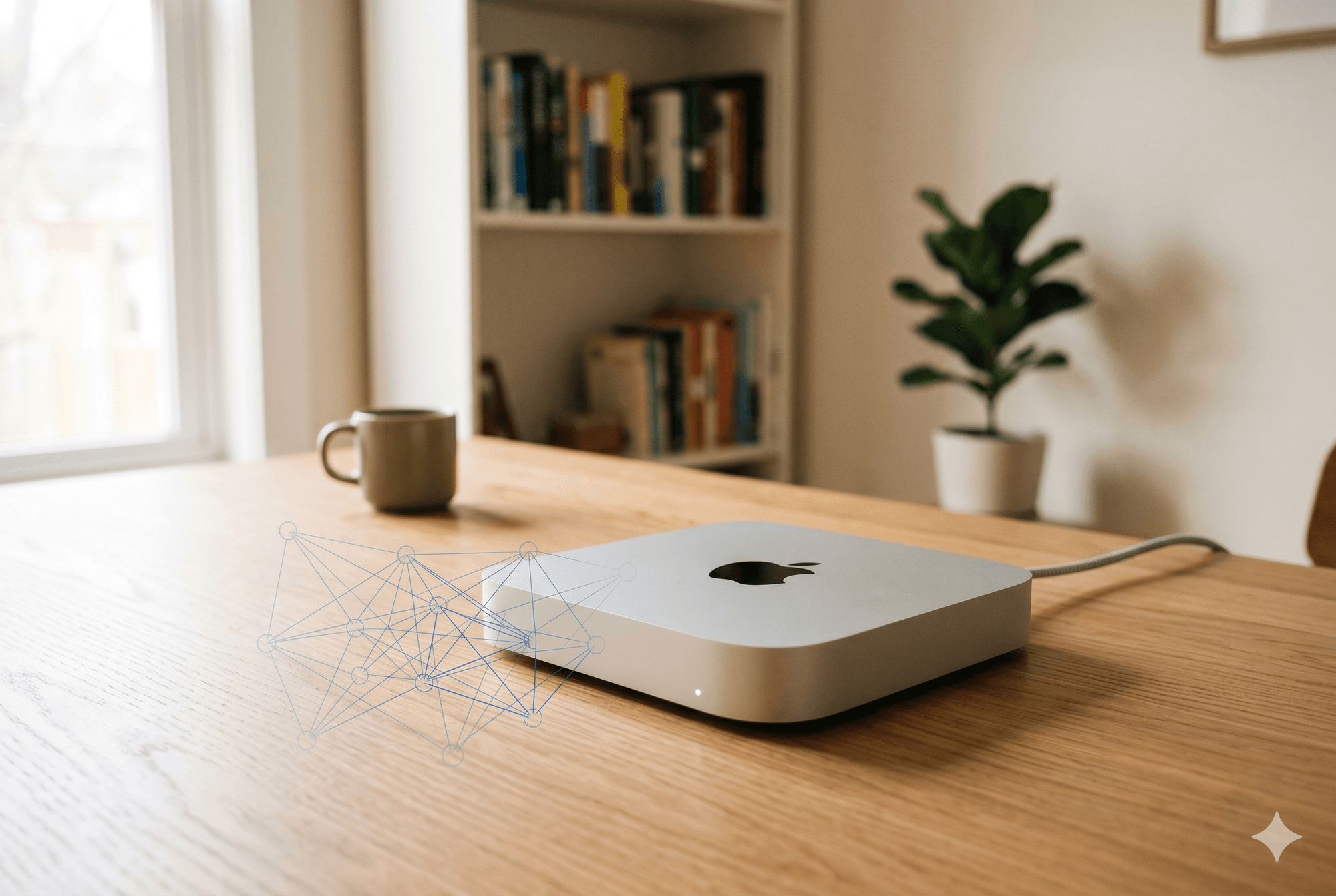
I'm training an AI model. It's going to run on a laptop. Three weeks ago I would have told you I was training a 70-billion-parameter model, the kind of thing that needs a data center to breathe. I'm not. I'm training a 4-billion-parameter model that runs on a Mac Mini. If the smaller one works, a larger companion model may follow. But the 4B is the bet. This is the first post in a series where I'll share what I'm building, why,

EssayPublished Historical context

Why I'm Open-Sourcing My Portfolio

What active thesis investing actually looks like — and why I'll publish every bet I make.

EssayPublished

I Tried to Buy a Mac Studio This Week. Here's What Happened.

Historical research — October 11, 2026: This records my April 14 shopping experience. Store inventory, rental rates, reported benchmarks and future-chip rumors below describe that period, not current buying guidance. Apple’s March 2025 specification gives the M4 Max Studio a 36GB starting memory configuration. The rental arithmetic is illustrative and does not establish equal throughput, currencies, taxes or total ownership cost

EssayPublished Corrected · see note

We Swapped Our TTS Model. The Older, Free One Won.

Model and comparison context — October 11, 2026: This is our April 8 model-swap account and listening preference. It does not include exact tested checkpoints/revisions, matched audio samples, blind listener ratings, latency or cost logs. For reference, the official Qwen3-TTS-12Hz-1.7B-Base card lists Apache 2.0, while Voxtral-4B-TTS-2603 lists CC BY-NC 4.0. Those cards identify specific artifacts; they do not prove which revisi

EssayPublished