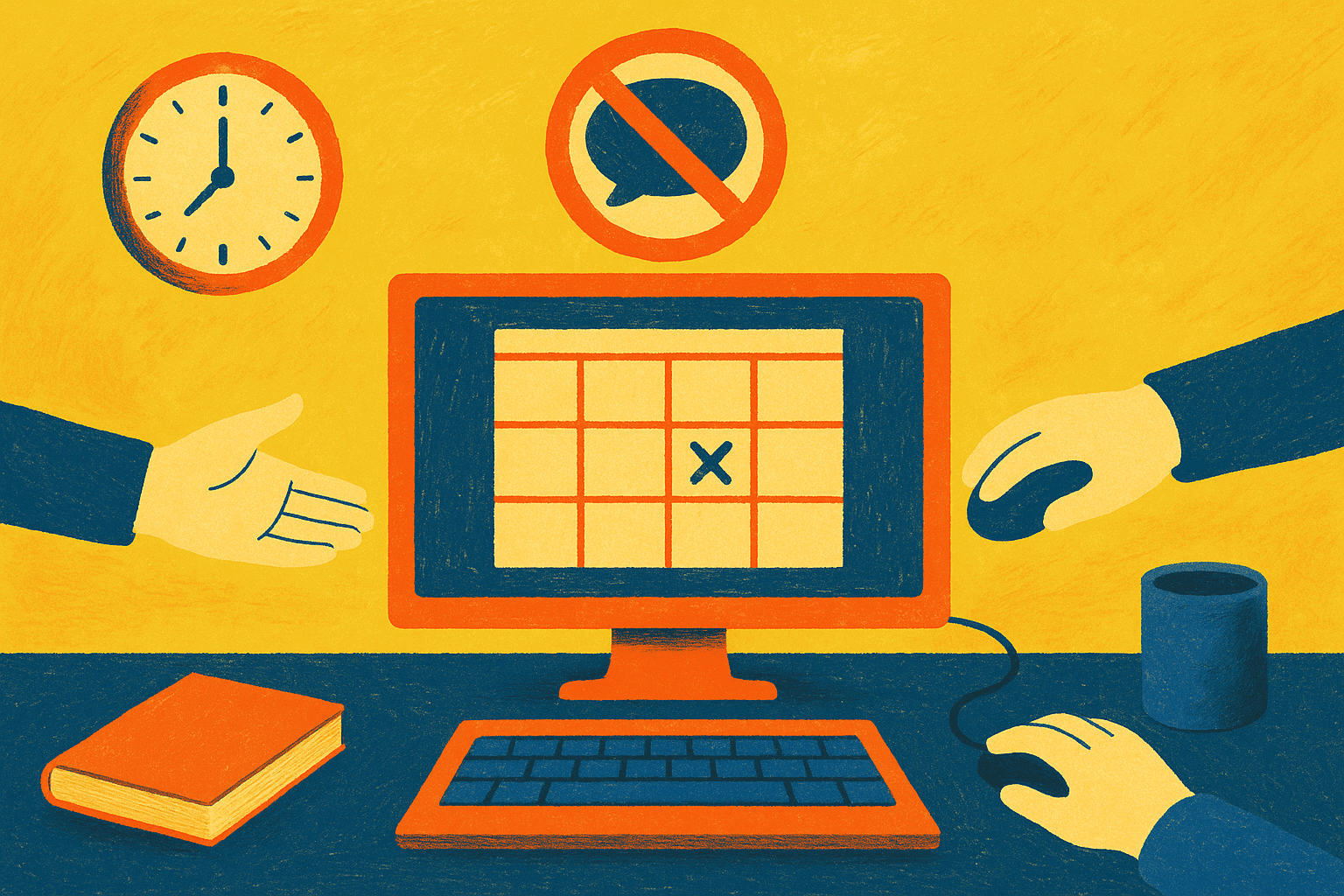
Small-team coordination experiment — October 11, 2026. This September 2025 calendar account concerns a selected team and period, including occasional client calls and spontaneous calls. It is not evidence that all meetings are unnecessary or that eliminating them caused higher profit. Before changing a cadence, identify the decision owner, a written status/decision record, an agreed response window, a channel for blockers and urgent escalation, and coverage during absence. Test one low-risk meeting change and check missed decisions, delays and workload; retain meetings required by actual coordination needs and obligations.
Real talk from a technical founder building AI-powered businesses
Published September 24, 2025 • Based on Founder Reality Episode 21
Also available on: Apple Podcasts • Spotify • YouTube
I just looked at my calendar for this week. Zero meetings. Last week? Zero meetings. The past couple months? Maybe one or two client calls per week, that's it.
Most founders think this is impossible. "How can you run two companies without meetings?" But here's what I've learned after six years of building businesses: meetings don't make you productive. They make you feel productive.
There's a massive difference, and it's costing you more than you realize.
The Meeting Theater That's Killing Your Startup
When I started as a product manager intern before COVID, everything felt "professional." Weekly all-hands meetings. Daily standups ranging from 15-30 minutes. Team culture meetings, planning meetings, review meetings. My calendar was packed, and I thought that meant I was important.
Then the pandemic hit, and meeting culture exploded completely. Suddenly everyone's calendars were back-to-back-to-back. Seven, eight meetings a day. It was insane.
But here's the problem: I was mentally checked out from 90% of those meetings. I'd be reading Hacker News during standups, going through the motions, making up accomplishments to sound productive. I was spending more time talking about what I was doing than actually doing the work.
It was all theater. Pure performance.
The $60 Million Wake-Up Call
My revelation came in 2022 when I met a Thiel Fellow who was 22 years old. This kid had already had a $45 million exit and raised $60 million for his current startup in less than a year.
When we were talking, he showed me his calendar. It was completely empty.
"George, I don't have any meetings. Let me show you." And there it was - Google Calendar with literally zero scheduled meetings.
Here I was, stuffing seven to eight investor meetings per day, completely exhausted at the end of each day.
Meanwhile, the most successful founder I knew had zero meetings while building a sophisticated company requiring both physical and software products.
That's when I started asking the hard questions:
- What are we actually accomplishing in these weekly one-on-ones?
- Are these meetings making us more productive or just making us feel productive?
- Am I emotionally drained by my meeting schedule?
The answer was uncomfortable but clear: most meetings are just performative productivity.

How to Actually Eliminate Meetings (The Framework)
Here's exactly what I did, and what you can do starting today:
- Review One Recurring Meeting at a Time
For a low-risk recurring meeting, agree on a written replacement and owner before testing cancellation. Keep meetings needed for decisions, support, feedback or required obligations.
Replace those time slots with personal reflection time. Instead of a support meeting where you passively listen, give yourself 30 minutes to actually review support metrics, read customer queries, and identify bottlenecks yourself.
Then make decisions. Don't schedule a meeting to discuss what you learned. Either hop on a quick 10-15 minute call with your lead, or better yet, just summarize your points in a Slack message.
- Focus on Spontaneous Work Sessions
When I need something from someone, I hop on a quick Slack call. Sometimes it's five minutes, sometimes 30 minutes. But we do it when both parties want to have that conversation, not because it's Tuesday at 2pm.
The key difference: these meetings happen because there's actual work to be done, not because it's on the calendar.
- Match Participation to the Decision
This is my hard rule. When you have more than three people on a call, the conversation quality drops dramatically. There's always going to be one or two people just listening, and that's awkward and wasteful.
Use asynchronous input when it fits the work; some decisions need more than three participants. Explain the purpose and required input rather than applying a universal headcount limit.
- Track Your Energy Levels
Recurring meetings were the first ones I wanted to review. Any cancellation test still needs the written replacement, decision owner, coverage and preserved obligations described above.
I started tracking: Does this meeting concretely change what was supposed to happen? Or could I have made this decision on my own?
90% of the time, the meeting wasn't necessary.
The Results Speak for Themselves
Since eliminating recurring meetings, my team and I are:
- Faster at shipping - no more waiting for the next sprint review
- Better at solving customer problems - direct communication instead of meeting overhead
- Much happier - team members consistently tell me they prefer this approach
- More profitable - less coordination overhead means more time on actual work
Even my ex-employees have told me they didn't love the meeting culture when we had it. It wasn't a good use of their time.

What About Team Culture and Alignment?
People always ask about team culture. Here's the thing: solving hard problems together builds team culture. Sitting in weekly status meetings doesn't.
We still have occasional social activities for those who want them (our GeoGuessr sessions were legendary). But we've removed the meeting stress that actually makes people unhappy.
For alignment, asynchronous documentation keeps everyone involved and aligned better than meeting attendance ever did. If something's urgent, we have spontaneous one-on-one conversations.
Most importantly: your company should be driven by results, not meeting attendance.
The Sunday Night Test
Here's how you know if your meeting culture is broken: How do you feel Sunday night about Monday morning?
Dreading a packed calendar is a reason to investigate workload and meeting design. It is not proof that the business is broken.
Energy levels don't lie.
Your 30-Day Challenge
Try this for the next two to three weeks:
- Cancel all recurring meetings
- Replace them with personal reflection time
- Use spontaneous calls only when needed
- Track missed decisions, response delays, unresolved blockers and workload
- Monitor your energy and productivity levels
My selected experience was positive. Other teams may lose useful coordination; compare the trial with actual delivery and team feedback before expanding it.
The Bottom Line
Most people have meetings because that's what they think companies do. But the most successful founders I know focus on execution, not coordination theater.
Your competitive advantage isn't how many meetings you have. It's how much real work you get done.
Stop performing productivity. Start actually being productive.
What's your meeting situation like? Tweet me @TheGeorgePu - I'm curious how many recurring meetings you're currently trapped in.
New episodes of Founder Reality drop Monday/Wednesday/Friday at 9am EST. Real founder insights, not startup theater. Full episodes and transcripts at founderreality.com